New simplified device brings easy installation and superior price/performance
BroaMan is set to launch a standard version of its popular Route66 configurable router series.
The attraction of the device is that it offers Auto Routing and an intelligent fibre patch bay (replacing the traditional patchbay)—this functionality powered by Optocore—making it ideal for installations with multiple connection points and mobile stage boxes as well as live events and broadcast.
The Route66 family already has four members, which are ideal for high performance customized video/audio designs. This latest fifth version is targeted for simple and cost effective standard cable management usage—specifically for the AV market and AV friendly data centres and server rooms.
The new 2RU design makes Route66 applicable to standard smart fiber patchbay applications. This smart patchbay allows routing of fiber/copper cables by software instead of a manual patch, enabling automated IP workflows and remote cable management. It also allows fiber/copper conversion without external devices.
The Route66 platform itself provides single channel, non-blocking 40 x 40 router ports, and the new standard version of Route66 will offer 40 SFP+ slots for 40 hot-swappable bi-directional SFPs with each slot up to 4Gbit performance. This is ideal for the vast combination of signals popular in the AV world, such as Ethernet, Fiber, up to 4K SDI, HDMI, Optocore, MADI and so on. A wide range of fiber transceivers is also available, while the use of all SFP+ slots guarantees superior EMI performance.
The Route66 family offers built-in redundant power supplies and extremely low power consumption of 10W-40W, making the system significantly more cost and energy efficient than competitive models which depend on external 120W PSU’s. The models are designed with a very efficient passive cooling system, which replaces noisy fans—therefore the device fulfills all noise criteria.
BroaMan MD, Tine Helmle, cites the possible different combinations of any protocol in just one device as a real advantage. “We have already installed many Route66 devices in server rooms and data centres, where our users love the remote routing flexibility. They simply do not have to walk long miles to server rooms anymore when a cable patch change is needed. Now, with this streamlined unit we have been able to simplify these installations further. Every AV server room deserves a Route66.”
All connections are to the rear, thus making Route66 installation friendly, and ensuring server racks are kept clean.
The new Route66 is shipping with immediate effect.
BroaMan’s AutoRouter with Optocore® technology adds Avid AVB and Yamaha TWINLANe compatibility Smart auto-patchbay solution for theatre sound designers
The popularity of BroaMan’s Route66 AutoRouter with Optocore® technology has continued apace since the streamlined version of associated company BroaMan’s Route66 first debuted on the Coldplay tour. Since then the Route66 AutoRouter has featured in a slew of high profile installations, including the Westfield Centre in London, Europe’s largest shopping mall, and Luzhniki Stadium in Moscow, redeveloped for the FIFA World Cup.
The attraction of the device is that it offers Auto Routing and an intelligent fibre patch bay (replacing the traditional patchbay)—this functionality powered by Optocore—making it ideal for installations with multiple connection points and mobile stage boxes as well as live events and broadcast.
Initially compatible with stand-alone Optocore networks and DiGiCo fibre loops, BroaMan has announced that the same functionality is now available for Yamaha TWINLANe cards, which support single-and multi-mode optical fibre, and AVID AVB network cards, allowing smarter theatre sound systems to be designed using their flagship consoles.
So how will this benefit the system designer? Essentially, what Route66 AutoRouter does is create a redundant star out of ring topology and closes the loop automatically between active devices and mobile stageboxes. There is no longer the need to patch cables manually, as the system is always redundant. Route66 will function as an intelligent patchbay, automatically detecting active devices and forming a loop topology from them to establish redundancy, without any user interaction. This speeds up system layout and configuration for any production.
The device can be equipped with up to 40 duplex LC sockets allowing up to 20 different connections from different locations, devices or device groups.
HD Pro Audio provides fibre infrastructure for Europe’s largest shopping mall
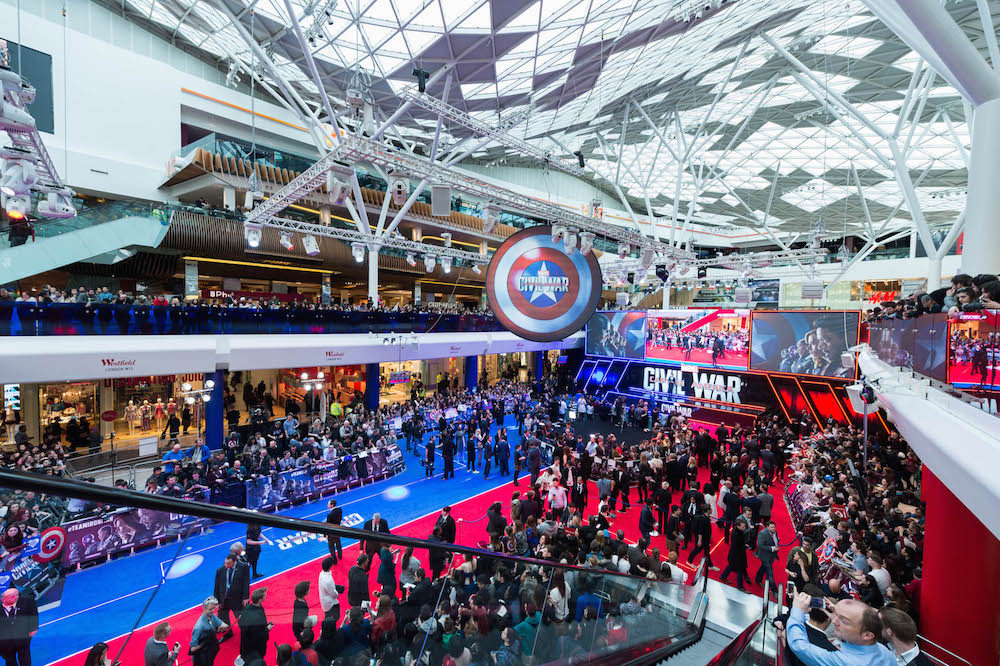
Westfield London has become not only the largest shopping mall in Europe, following its new £600m extension this Spring, but it also hosts more than 300 events a year. In addition to its vigorous retail activity, this includes concerts for as many as 4,000 people, with relays to their giant retail screens and multiplex cinema.
Building a network infrastructure to carry the myriad of communication signals and IP addresses over fibre across the 2.6 million feet of real estate (or 1km end-to-end) has been an organic process, which has been made easier since owners, Unibail-Rodamco-Westfield (URW), in conjunction with audio consultants HD Pro Audio, employed Optocore’s BroaMan routing matrix system.
The Westfield Events team became aware of Optocore products in 2011, during the planning of sister operation Westfield Stratford City, but it was not until 2015 that it was decided the BroaMan system would be an ideal solution for video/ audio distribution. The systems designed and specified in 2015 have now been extended exponentially by current Senior Technical Manager, Ben Davies.
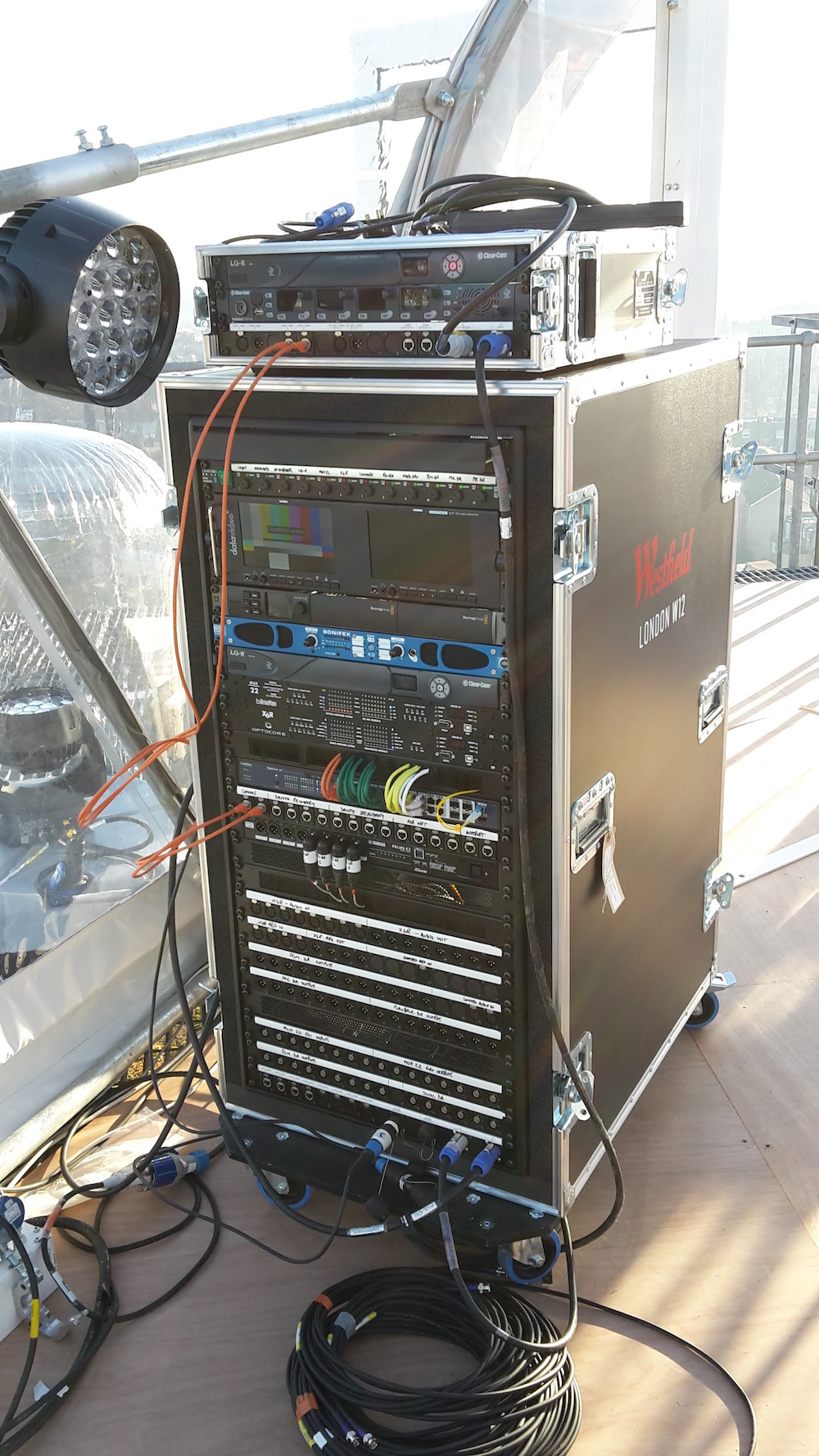
A split inventory of seven remote BroaMan racks can easily plug into facility panels in any public or back of house spaces, in order to link events together. The new outdoor event space, Westfield Square, was specified with a grid of 37 floor traps, each with fibre connections, enabling visitors to enjoy the Royal Wedding earlier this summer from deck chairs on London’s largest external full motion video screen above the Square. “The idea was always for an easy plug and play solution, to quickly link one area to another,” says Davies.
Initially the Event production team had looked to hire companies to provide temporary solutions for ad-hoc event signal distribution. Huge networks of temporary copper cables were therefore run across event spaces and service yards to facilitate this.
As the event infrastructure grew, and with IP connectivity becoming far more prevalent, HD Pro Audio’s Andy Huffer quickly made the case for Optocore and BroaMan, knowing it would cut down the cumbersome business of patching, and at the same time provide a less expensive option than copper, particularly with add-ons such as the construction of a video gallery. “They needed long distance audio feeds with a routing matrix because the point-to-point feeds were time consuming and fraught with problems. They were initially interested in Optocore but I informed them that BroaMan took the platform a lot further,” he said.
A BroaMan Route66 40 x 40 with hot-swappable, bi-directional SFPs, accompanied by external WDM frame, was proposed initially for Westfield London — and this was copied for Westfield Stratford City.
Both the Shepherds Bush and Stratford racks are identically configured, with a Route66 Optocore AutoRouter, Route66 40×40 Video Router and WDM Frame; 3 x Mux22-IVT/IVT 8 SDI-In/8 SDI Out and 3 x X6R-TP 8MI/8LO. Each system has the Route66 central matrix with a single Mux22 and X6R in the control room, with the remaining Mux22 and X6R combinations in remote racks.
The systems were installed in-house by the URW Events technical team, with specialist wiring completed by David Tyler of Tower Communications. The systems were commissioned onsite by BroaMan Technical Sales Manager, Maciek Janiszewski.
As for the second phase at Westfield London, which increases the indoor space by a third and adds the outdoor pedestrianised Westfield Square, HD Pro Audio have provided a further Route66 Optocore AutoRouter and Route66 40×40 Video Router with WDM Frame, as well as 5 x MUX22 8 SDI-In/8 SDI-Out, and 5 x X6R-TP 8MI/8LO.
Before committing to the system, URW had rigorously evaluated the platform against another proprietary media distribution network. “However, we felt that BroaMan was more of an installation product with greater immediate feedback on the front panels— and that the BroaMan product was generally a better solution for our needs,” reasoned Ben Davies. “Maciek (Janiszewski) would tell us, with total confidence, that if their system didn’t provide features we wanted, they would simply add them for us.’”
Maciek himself recalls the original concept discussion had taken place at the BVE Show in London many years earlier. “Over the years we met frequently at trade shows, and built a strong personal relationship with them. Finally we came up with the solution that met their exact requirements.” This was at Prolight+Sound two years ago.
As a result, URW became the first adopters of the Route66 40 x 40 layout. ” Once we delivered the system it just worked smoothly straight ‘out of the box’. Even though it was quite a large project, with a completely new core hardware router, we were completely confident. It was reassuring that URW trusted us sufficiently to become the first to use the new product.”
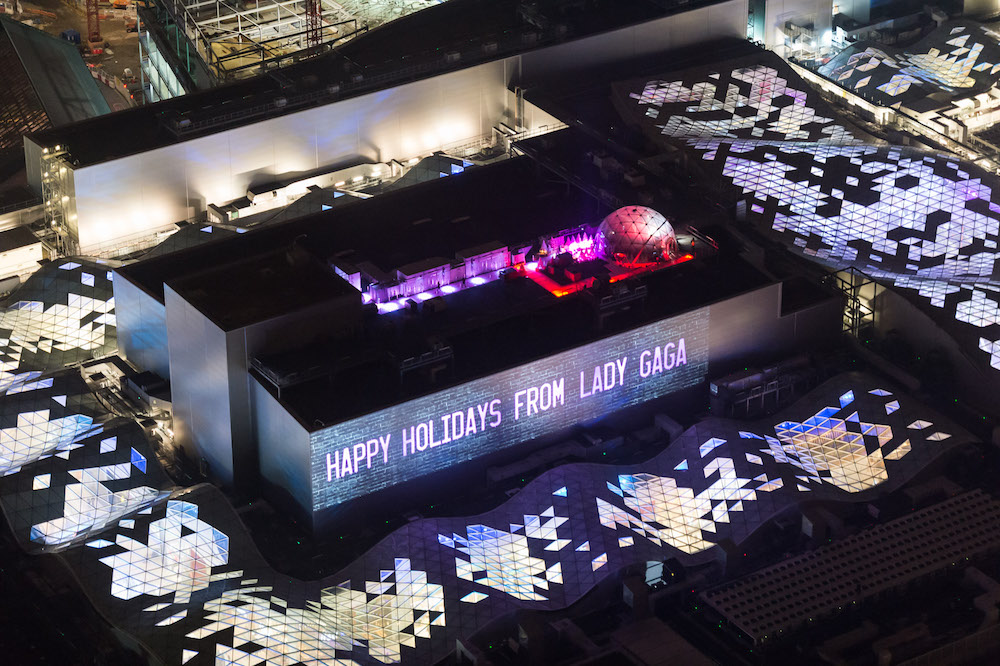
The first Broaman / Optocore deployment could scarcely have been higher profile, when Lady Gaga took to the roof in December 2016, where a ‘snow globe’ had been specifically created to enable her to perform an intimate gig for a 100 prize-winners, with the action relayed to the multiplex cinema at the top of the building, which itself has already hosted several major film premieres.
Typically, says Davies, for major events, a BroaMan rack would be situated in the FOH control position, another at BOH, one in the press pen, and a final rack at an external location where broadcast trucks park up with line of sight to satellite uplinks. These are all linked together by the Route 66 matrix in the Control Room, routing the correct signals to the correct places.
The remote racks include all the D/A splitting necessary for local audio and video connections, along with Clear-Com LQ series outstations for communication links.
“As for the [Route66] AutoRouter, if a rack is unplugged, or unused for an event, this will automatically reconnect what is effectively a loop system, without internal re-patching.”
The BroaMan system offers the ability to tunnel through two additional IP streams by fibre. These connections are used for Gigabit connections from a network of Luminex Gigacore switches to stations within each mobile rack. Port aggregation on the Luminex switches allows a maximum 2 Gb bandwidth to each remote switch. This addition to the BroaMan racks takes care of all IP traffic – including MA lighting systems, ClearCom communications, internet connections, and various device management connections.
Rita Ora Switches On Christmas Lights at Westfield London, Shepherdís Bush
A redundant stack of Cisco 550SG fibre switches in each control room provides the backbone for the Luminex network.
In terms of signal flow, for the Lady Gaga show, video/audio signals from the event on the roof were sent (by single-mode fibre) from the remote rack Mux 22 unit to the control room Route 66 downstairs; the signals were then routed to the video gallery (where it was vision mixed) and then output to broadcast trucks on the other end of the complex, and the cinema screens upstairs.
“Innovation is extremely important to us at Unibail-Rodamco-Westfield. It is fantastic to have developed and deployed such systems with our consultants and manufacturers, which helps us deliver large scale events, often to tight timescales,” says Ben Davies in conclusion. “We are very proud to have the opportunity to work with so many A-list stadium acts, demonstrating the value of the ‘Westfield’ brand.
“Optocore and their BroaMan system is now central to the behind-the-scenes technical delivery of these events. With so many SDI signals, audio signals and IP streams I don’t think we realised just how great the benefits of BroaMan would be. The way the Optocore team has worked with us on these systems makes us feel more like a member of an extended family, than customers.”
Late last year, with the announcement of the Route66 Redundancy Manager, German network fiber giant BroaMan introduced the capability of full automatic redundancy switchover between devices, by harnessing the power of Optocore. This would enable switching between Route66 Video Router and Mux22 nodes — using smart mechanism to detect when one of the fiber links between the nodes is broken.
Now the same technology has been enabled in a very popular point-to-point system — between a pair of Mux22 devices. Mux22, which combines 3G SDI I/O and video sync, with Optocore and SANE digital audio networks, now also features full automatic redundancy. Thus should one of the links fail, the system would automatically switch to the redundant path, enabling all video, audio and data channels to remain working. The switchover time is near instantaneous — implemented in just one sample length.
Now this facility is available for any Mux22 device – 16 video (IVT/IVT), 8 video and 8 intercom ports (IVT/Intercom), 8 video and 4 Line I/O (IVT/IC444), 8 video and 4 MADI (IVT/MADI).
Stated BroaMan Technical Sales Manager, Maciek Janiszewski, “Optocore has been offering redundancy as a standard for years while in broadcast and video world redundancy has never been an important feature. All this changed when muti-format single-cable solutions like Mux22 appeared on the market. We realised we could use Optocore’s experience and smart fault detection algorithms for adoption into BroaMan’s best-selling series. Thanks to the Optocore technology we can make the redundant switchover both automatic and seamless.”
BroaMan has further extended its successful Mux22 series of devices, with the announcement of the Mux22 FrameSync8, which provides a superior upgrade to traditional frame sync technologies.
By using revolutionary advanced timing and transport techniques, the new FrameSync option allows zero-delay frame syncs, and auto-adjustment of its embedded audio. This addresses a number of problems which began with the use of digital equipment, notably the infamous lip sync issues and highly irritating delays for actors and conductors in live situations. These are now a thing of the past.
The popular Mux22 is a universal interface, supporting all broadcast industry signals in just a 1RU chassis. By combining HD/3G/6G/12G-SDI I/O with Ethernet, Optocore and SANE digital audio networks, Mux22 provides a compact and highly efficient solution for transporting video, audio and data on just a duplex fiber.
Each standard Mux22 can now contain a FrameSync board which allows Video Frame Sync of eight Video Inputs (eg for cameras). This new FrameSync option, which will receive its official launch at this year’s IBC Show in Amsterdam, is based on the new FrameSync8 board, which provides eight Sync Outputs in addition to the ever-present two VSync (Video Sync Board) I/O option.
This traditional VSync I/O, which appears inside every Mux22, is independent from the new FrameSync8 board – for example, VSync can still perform the black burst-to-audio clock synchronization, while the FrameSync8 outputs can produce indepenently phase shifted video syncs of any style, both black burst and tri-level, of numerous resolutions, in all PAL/NTSC/SECAM SD and HD versions.
Additionally, each of the eight Sync outputs in FrameSync8 can be individually set to either Video Sync or Audio Word Clock Sync, making the device a perfect video and/or audio sync distribution device. This will replace, in most cases, all ambiguous black burst sync generators/splitters, word clock generators/splitters and black burst sync–to-audio-units with their mostly unknown phase relations, unknown phase shift and high jitter designs.
Thanks to BroaMan’s rock solid technology, the phase shift and format of Video Sync are precisely matched to all eight outputs, with a guarantee that there will be no mismatch in timing. In FrameSync8 BroaMan promise that any short circuit of one output will not affect any other port. Superior low jitter < 50ps and ‘same phase relation on every power-up’ is always guaranteed.
“This product is the result of a popular request in SDI stagebox application,” states BroaMan Technical Sales Manager, Maciek Janiszewski. “Previously, our customers would have had to use 2-3 additional devies, like external Black Burst Sync Splitter device to provide Sync signal to multiple cameras. Now they can provide 100% precise sync to all cameras from Mux22, at the same time feeding Mux22 with time-aligned video and audio signals. But what is most amazing, the new technique allows a frame sync with zero-delay of the video signal, which removes a bunch of trouble for operators and allow the audience a much better video/audio experience.”
The new Mux22-FrameSync8 begins shipping with immediate effect.