Point-to-point fiber tunnels increase the range of options over vast distances
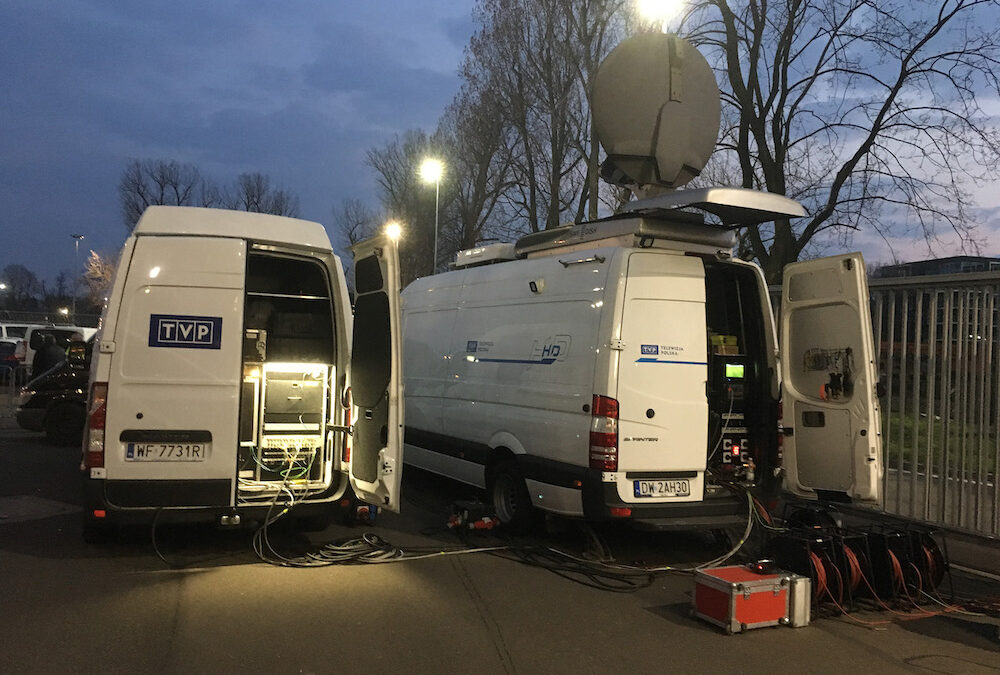
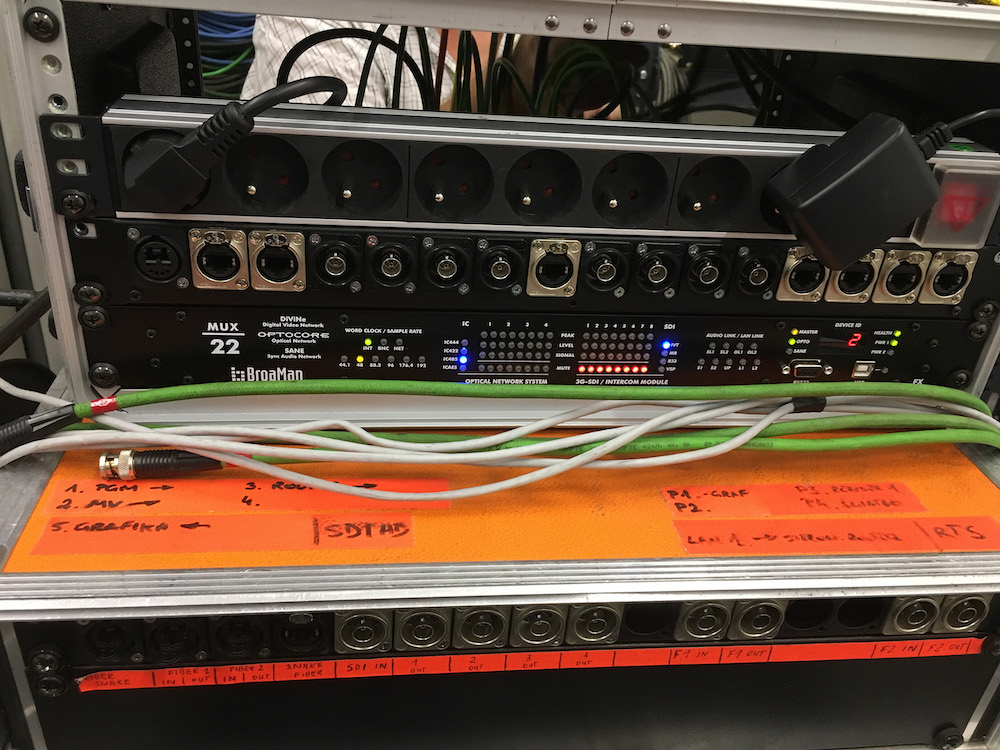
BroaMan has provided an elegant point-to-point fiber solution to TVP, the Polish national broadcaster, as part of an upgrade to an OB van. Critically, the Mux22 platform specified offers automatic redundancy.
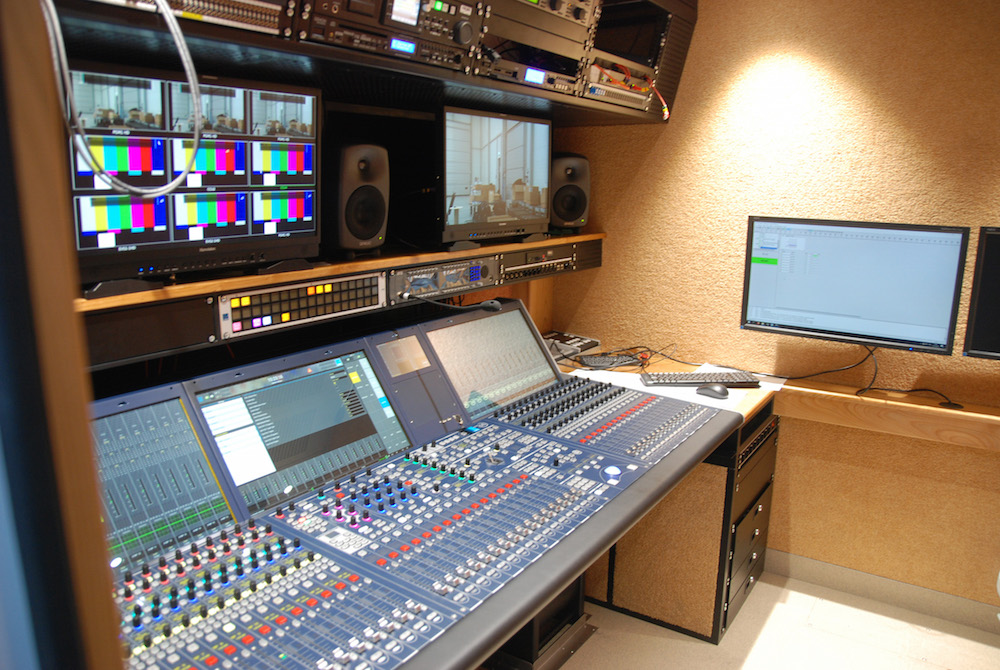
The DSNG satellite OB van, stationed in Wroclaw, was first modernised in 2015 and now functions as an 8-camera production truck and at the same time a satellite uplink.
TR Broadcast, a trading partner of TVP for several years, successfully responded to the tender for the supply and integration of the new infrastructure.
According to TVP’s Andrzej Wiszniewski, who is in charge of DSNG in Wroclaw, the main goal of the upgrade was to increase the range of devices such as monitors, controllers, intercom and large outdoor screens. “Our vehicle will be used by TVP throughout Poland and other parts of Europe (Germany, Austria, Czech Republic, Hungary). It will serve sporting events (football, volleyball, basketball, horse racing, handball, hockey, archery, judo, boxing), as well as concerts, conferences and more,” he said.
The possibility of a MUX solution had been proposed by a colleague engineer from RTS Intercom Systems. “He was the first to mention BroaMan MUX devices,” confirmed Mr. Wiszniewski. “The first task was to send intercom communication to the RTS desktops during the Four Hills [ski jumping] tournament. The distance from my OB van to the TV studio was around 800 meters. The MUX devices create two fully redundant point-to-point optical fiber tunnels, with switching between tunnels taking place automatically without interruption to the signal.”
Mr. Wiszniewski said that the capacity the MUX22 solution offers had become immediately apparent. “From the moment we bought the device, we could: send intercom signals to four external RTS desks located away from the vehicle — from over 100m to 10km; send eight HD video signals to and from the OB van to the transmission site (eg stadium, Skybox, commentator positions over distances from 100m -10km); send control signals, I/O synchronization, and transmission of LAN network signals.”
He is delighted with the specification, stating that other systems he had evaluated were either more expensive or occupied a lot of space. “I had been looking for an economical and reliable solution for a fiber optic platform for television devices for a long time. With many solutions available on the market BroaMAN MUX 22 proved to be the best choice for my current needs. Thanks to these devices I am relaxed about all my signals transmitted over long distances.”
“The fact that this is also a device with automatic redundancy is another very important factor, because there is no room for error in the production of live programs. Thanks to this solution, I can lay two separate cable ways, or one multi-pair. This allows a very quick response in the event of a fault.”
SFL installs redundant fibre network and largest ever one-room speaker set-up
London’s iconic Royal Albert Hall has completed the biggest improvement to sound in its auditorium since the installation of the iconic acoustic ‘mushrooms’ 50 years ago.
Costing over £2 million, the project took 693 days of labour, 15,291m of cable, and 465 individual speakers, in the world’s largest loudspeaker install in a single room.
Main array, circle, gallery and box speakers installed 2019
With equipment supplied by Autograph Sales and installed by SFL, the digital distribution network adopted a ring topology and the selection of multi-format I/O cards included analogue, AES, ANA, DMI Optocore and DMI Dante.
Within this, a pair of BroaMan Route66 Optocore AutoRouters, managing Optocore links from the DiGiCo desk environment, have been specified as central routers in a redundant starred network—this is to cater for the large number of patch panels distributed around the venue to the d&b audiotechnik loudspeakers.
Compatible with Optocore and DiGiCo fibre loops, the added functionality of the AutoRouter on the Route 66 makes it ideal for large installations such as this where there are multiple connection points.
Main array, circle, gallery and box speakers installed 2019
As a Grade I listed building, the intricate new sound system proposal required special building consent and had to work within the fabric of the famous Victorian venue.
The project drew on the most detailed acoustic surveys and modelling ever undertaken in the Hall, courtesy of leading acousticians Sandy Brown, and ground-breaking installation methods.
The new system also features the first ever circle, gallery and box speakers, bringing the sound closer to all seats, radically improving levels, tone, and clarity for every seat in the house, meaning sound quality is now equal throughout the Hall for the wide range of programmes hosted, ranging from boxing to ballet and everything in between.
Craig Hassall, Chief Executive of the Royal Albert Hall, said, “This investment is about more than just updating the sound system, it’s about future-proofing the building as we approach our 150th anniversary in 2021, so that it is fit for another 150 years.”
Incredibly, none of the several hundred shows that took place during the installation period were stopped or affected, thanks to an overnight engineering work schedule carried out by installation company SFL.
4vision carry out installation for major Polish broadcast facility
A member of Poland’s large ATM Group, ATM System is one of the country’s leading TV production companies, with a large fleet of OB vans and broadcast equipment.
The company recently commissioned a new top of the range UHD 4K OB van and 4vision, who have enjoyed a long-term relationship with the broadcaster, successfully responded to a competitive tender.
Having built an OB van for ATM some years ago, they acted as consultants, on issues ranging from coach-building, through equipment proposal, interior and technical design, to cabling and setup.
The OB has been built around 16 Sony HDC-4300 4K/HD cameras, and two LMP Cerberus 4000 miniature cameras, and is equipped to take an additional four wireless cameras.
A BroaMan system, powered by Optocore, has been specified to send video and audio signals to and from the field, for use by journalists and technicians backstage.
Local units include two BroaMan Repeat48 optical converters for video I/O, Route66 as fiber router, with TX and RX, and Optocore M8-OPT optical MADI switch for audio connectivity to the LAWO M56 mixing console via a GVG Sirius router.
In each of two video stageboxes there is a BroaMan Mux22-IVT/IVT (8 SDI IN/8 SDI OUT) multi-signal transport device and Optocore X6R-TP-8MI/8LO converter. This feeds programme audio to backstage for use with loudspeakers and/or commentary systems. It can also be used as backup for the audio stageboxes, if more I/Os are required, or needed for other locations. In the future, mic inputs will be controllable directly from the Lawo console via the Optocore / Lawo Special Mode).
However, the Route66 not only transports the signal between local SDI I/O from the Repeat48 and stageboxes, as 4vision project manager, Pawel Fila points out. “We also use LAN, two in each stagebox patch panel, for example with the Lawo VSM control panels. Each stagebox is also ready to connect their EVS control unit via RS422, and ‘dark fiber’ networks using the AUX connection. And so it handles nearly everything …”.
BroaMan provided full installation support to 4Vision — from system design to training. The new van will now be assigned to general duties, not only in Poland but beyond.
Pawel Fila confirms that the installation meets the client’s remit in full and the BroaMan and Optocore devices have functioned flawlessly.
Betamobil again produces the Alpine Skiing World Cup events for ORF at all locations outside of Austria for for the 2018/2019 season. Two OB Vans: the HD6 and the HD7, were, are and will be on the road in 17 European race Locations including the World Cup Final in Soldeu / Andorra.
To simplify the technical infrastructure, 2 BroaMan MUX22 systems, each with one Optocore X6R-TP, are used at each World Cup location. This allows the set up of xtremely flexible stage box systems for the transport of all the required signals to the presenter / interview position as well as to the commentator position.
Each stagebox only needs2 single mode fiber cables. This simplifies the wiring efforts considerably. With Betamobil’s BroaMan / Optocore Stagebox systems, 4 HD-SDI 1080p50 video signals, 8 analogue audio signals, 2 IP network signals and the signals to 4 Riedel intercom panels (via AES paths) can be transmitted in each direction inexpensively.
To support the FIS World Cup Production for ORF Betamobil in a first step purchased a point-to-point BroaMan Set based on Mux22-IVT/ICAES. The first set (purchased in May 2017) was just two Mux22-IVT/ICAES allowing to transport 4 bi-directional 3G-SDI signals, 4 AES intercom ports for Riedel panels (4 GPIO, Sync and auxiliary fiber port – all on duplex singlemode fiber cables.
In December 2017, Betamobil purchased another set of MUX22-IVT/ICAES to extend their existing system for bigger applicationsThe third set (puchased in April 2018) is the same as the first two, but on each site Mux22 is extended with X6R-TP-8LI/8LO. Thanks to this on the same fiber they can additionally transport bi-directional 8 line level audio signals with the fourth set, Betamobil ordered another pair of MUX22-IVT/ICAES, extended with 2x X6R-TP-8LI/8LO (same as the third), plus an additional pair of X6R-TP-8LI/8LO, in order to enhance the audio capability of their first two pairs of Muxes Austria’s men continue World Cup domination as Vincent Kriechmayr wins Wengen downhill
Throughout the years no country has dominated the prestigious Wengen downhill quite like Austria — and no country has dominated men’s skiing in 2019 quite like the Austrians either. Austria’s Vincent Kriechmayr edged home favorite Beat Feuz by 0.14 seconds in Switzerland on Saturday to win the oldest, longest and fastest race on the men’s World Cup circuit.
In the 89th edition of the downhill race, Kriechmayr provided Austria with its 31st win in the historic race, while the 27-year-old’s victory also means an Austrian has won every men’s World Cup race in the 2018/2019 seeason so far.
In sunny and crisp conditions, Kriechmayr crossed the line in 2:28.36 to ruin Feuz’s hopes of claiming a third downhill title in Wengen. Norway’s young hope Aleksander Aamodt Kilde was third (+0.26) while veteran Norwegian Aksel Lund Svindal was fourth (+0.52).
To serve Austrias Ski Fans at home infront of their TV sets ORF takes the international signal ( in Wengen produced by tpc ag ) and produces a localized version with moderators in the mixed zone and sometimes with a local studio. For the technical support of this lateral production ORF has hired Berlin-based production house Betamobil.
Festival Box and Route66 Standard take centre stage
German fibre network associates, Optocore and BroaMan, combined their resources to great effect at the recent ISE 2019 expo in Amsterdam — as part of the successful portfolio of brands distributed in the Benelux by the Ampco Flashlight Group.
Traffic on the stand was permanently busy, both with recognised customers from the integration, event and broadcast sectors, as well as newcomers seeking further information about the unique custom solutions that the two specialists can offer.
Optocore showcased its new Festival Box, reporting high interest from both distributors and rental companies. The Festival Box allows all protocols to tunnel over the same fibre, with hot-swappable SFP optical module transceivers providing different conversion options to add massive savings in time and cabling to multi-act festival bills.
As Applications Engineering Manager, Maciek Janiszewski stated, “While festival sound engineers can transport whatever signal protocol their console supports via just a single duplex fiber, the value of the device does not stop there. It has also become a reliable backbone for multiple signals without the complex and time-consuming set-up. In particular, our RJ45 SFP transceiver is something very unique, as it allows multiple Ethernet-based protocols to run independently on the same fiber.
As for BroaMan, their flagship product was the new standard version of their customisable Route66, which already exists in four versions. The platform itself provides single channel, non-blocking 40 x 40 router ports, and the new ‘Standard’ version offers 40 SFP+ slots for 40 hot-swappable bi-directional SFPs with each slot up to 4Gbit performance.
“It is designed for simple and cost effective standard cable management usage specifically for the AV market and AV friendly data centres and server rooms,” continued Janiszewski, “and hence the huge amount of interest shown by the ISE visitors, particularly those already familiar with BroaMan and the previous Route66’s.”
In summary, BroaMan MD Tine Helmle said, “The enormous interest in both these products, coupled with the constant back-to-back meetings with our distributors during the show, has resulted in one of our most successful expos ever.”