Danmon Group Sweden has been appointed distributor for Optocore and BroaMan fibre solutions, having been representing the brands in Denmark for a number of years.
With business units across Scandinavia, and more than 25 years of experience behind them, Danmon Group has evolved to become one of the leading suppliers to professional users of equipment for broadcast, television, film and commercial productions, originally in its native Denmark.
Back in 2001, Danmon Sweden managing director, Marcus Lundahl, started to build the Group’s audio division, Soundware, after which they began representing Optocore.
While Soundware will continue to service the professional audio and video industry generally, Danmon will focus on addressing the broadcast video sectors with the German manufacturer’s scalable fibre interfaces, seeing huge potential in these segments.
“We primarily see Optocore and BroaMan penetrating a number of key sectors like broadcast, live OB, and theatre,” continued Mr. Lundahl. “Sweden has been an early adopter of new ways of distributing content — especially over fibre, where the interest is very high.” In fact SVT (Swedish Television Broadcast) was the first broadcaster to adopt a custom fibre solution leading to the original foundation of Broadcast Manufactur (BroaMan).
Although the company already has advanced knowledge of the Optocore / BroaMan fibre solutions Danmon/Soundware are already contemplating further staff training and will be promoting to their own client base via social media channels and websites, plus a series of roadshows and seminars.
In closing, Marcus Lundahl said, “This is a great opportunity not only to give customers the possibilities for more advanced connectivity and networking but also to introduce them to standard devices for every day use.”
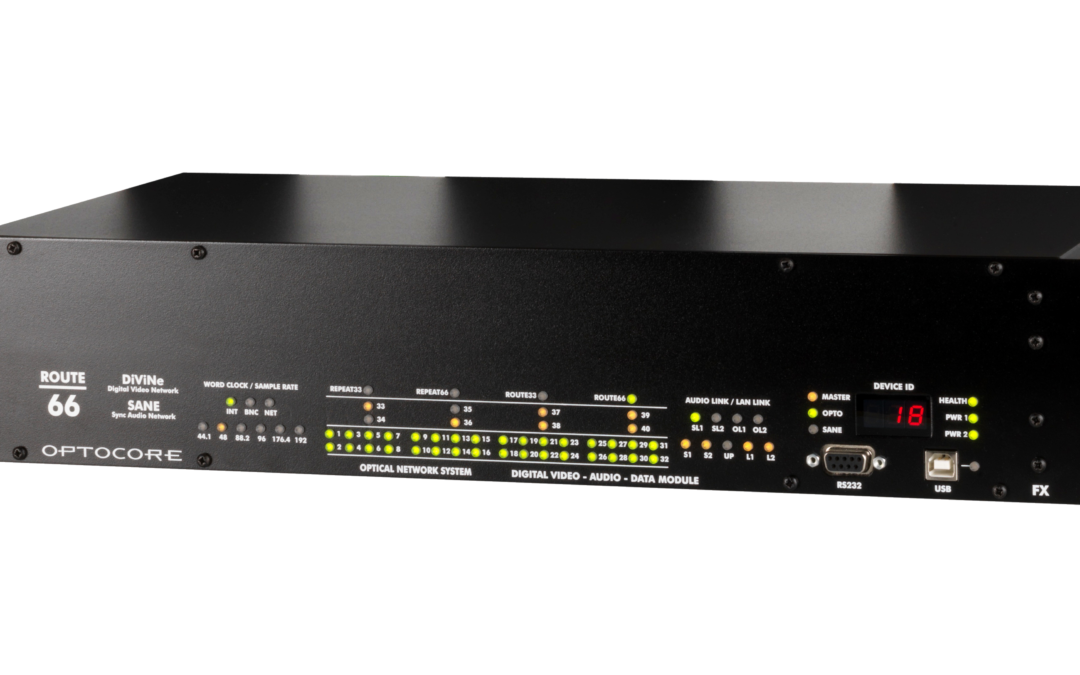
Tine Helmle, managing director of BroaMan, agreed. “In addition to constructing advanced and sophisticated fibre networks we are increasingly being recognized as a manufacturer, designer and reseller of products needed for daily business. From Optocore this would include our MADI devices and various converters and from BroaMan our popular stand-alone and point-to-point devices, including Repeat48, Route66 Auto Router and MUX22.”
Optical digital fibre-based network technology specialist BroaMan was incorporated in January 2012 by the founders of Optocore GmbH. The company provides products that are dedicated for using a fibre Infrastructure to integrate video, audio, intercom and other data on a redundant low latency system. Within that scope are, of course, technologies that are designed for use with IP solutions throughout the broadcast industry. As Managing Director Tine Helmle explains in an interview that covers a variety of areas, IP is good news for the company.
Has the growth of remote sports production using IP technology made a difference to your activities?
The growth of remote sports production using IP technology has turned out to be a very positive aspect for us and it has strengthened our market positioning. BroaMan is one of the main global suppliers for remote production and fully IP based systems. We started using Ethernet for transport in the year 2003. At that time, few, if any, other manufacturers had IP based products. Since then, we have continuously developed our technology and have now achieved the most advanced cost effect and reliable, plug and play fibre infrastructure on the market for IP based systems. For this reason, many broadcasters have decided to choose a BroaMan system. These include Swedish Television, SVT and ITV in the UK. Both have large BroaMan systems specially designed for IP based remote production.
Along the same lines, has there been a decrease in installation within OB trucks for your equipment?
No, the opposite is the case. Right from the start, the request for our equipment to be installed into OB trucks has grown and grown from year to year.
The reason for this is clear. Our products and technical solutions exactly fulfil the requirements of the builders, customers and user of OB trucks. Our IP based network infrastructure offers multiple formats such as SD-SDI, ASI, HD-SDI, 3G/6G/10G/12G video, audio, intercom and other data, being ready for 4K and beyond. This all comes in just a one Rack Unit device, the MUX22.
Having small, lightweight, one RU devices saves space, power and weight, which means the owner of a truck will have compact, yet powerful, systems while at the same time achieving huge cost savings in fuel and energy. Another key feature for OB vans is that our products are not supplied with a fan. That, of course, means there will never be any fan noise in the truck. Moreover, all our products operate on an extremely low level of power consumption. Again, the result is long term cost savings.
So, what [in what ways do] BroaMan products differ from other IP based systems? Our smart design results in very high bandwidth and a very low set-up time. And it’s made simple and user-friendly – you don’t need to spend money for an expensive IT specialist working days or weeks to set up the system. Just plug and play. The system is easy to operate and handle.
Apart from IP, are the demands of sports broadcasters and production companies changing when it comes to your range of equipment?
I think broadcasters want smaller and decentralised units. They look for fibre infrastructure including not only video, but also high quality audio and other data in just one system They want a system, which is compatible with all industry standards and an interoperability with many different formats. This is exactly what BroaMan systems offer.
With an increasing number of venues installing fibre, what kind of advice are you providing to those sites?
This represents great progress – the evolution that more and more venues now install fibre. We believe that IP-based workflows could be the future.
It is the most cost effective and reliable transport that we have seen during the last 20 years on the market. We have over 25 years of experience with fibre networks. Our recommendation is always, during construction or renovation, to simply put fibre everywhere. That’s because fibre can transport everything and with electrical isolation, you can decide at a much later stage what to transport, or even change a system for future needs. This increases flexibility immensely. You can use it when needed and you can open networks, rings or point-to-point connections – as I said maximum flexibility. I wish to see more experts of fibre transport in the industry in general, but I really believe that the number of them is steadily growing now.
Do you see engineering educational courses turning out the graduates with the skills to meet the challenges ahead for your part of the industry?
We see young skilled engineers coming now to the market, with knowledge of general IP. They have a good knowledge of data IP and networking. However, with video and audio streams, the situation is different from data, so also other skills are needed. Still additional expertise in fibre as a medium for video and audio transport is needed. This is an area that needs further training.
Are there any such projects that stand out as being particularly challenging – and how did you overcome that situation?
Most big broadcast installations are challenging and usually have individual needs. For exactly this reason, we’re offering from the beginning both modular and customised solutions, which are very well accepted by our clients.
Are there any plans you are free to discuss?
Our system is entirely IP based with additional video and audio engines. Therefore, we can transport almost unlimited bandwidths, up to 240 Gigabit per single fibre, and as many fibres as you want.
BroaMan is the leading specialist for transporting, routing and distributing video, audio, intercom and IP signals via fibre. Of course, fibre is the best solution for long distances and high bandwidth for any signal. And with BroaMan, switches are built in – so there are no extra devices necessary, including hubs or routers. This saves costs and reduces technical complexity. Another benefit is the built-in redundancy and a latency which is very low and does not increase when adding switches or having long distances to cover.
Cela a été un réel plaisir, pour nous, de participer aux JTSE 2016 à Paris. Nous tenons à vous remercier de votre intérêt pour nos produits et pour votre temps passé sur le stand. Notre stand était en permanence bondé, cela confirme la demande croissante pour nos solutions fibre, avec une infrastructure sécurisée; pour les médias, les besoins professionnels en installation live, fixe et de diffusion. Si vous avez des questions concernant notre technologie, n’hésitez pas à nous contacter.
It was a pleasure for us to have taken part at JTSE2016 in Paris. We would like to thank you for your interest in our products and for your time spent at the booth. Our stand was permanently crowded, which confirms the increasing demand for our fiber solutions and a secure, reliable infrastructure for all media for professional requirements in live, fixed install and broadcast applications. If you have any questions about our technology, please don’t hesitate to contact us.
For interested parties operating in France, our local representatives are at your disposal: Philippe Moreau p.moreau@broaman.com and Gilles Bouvard gb@gillesbouvard.com
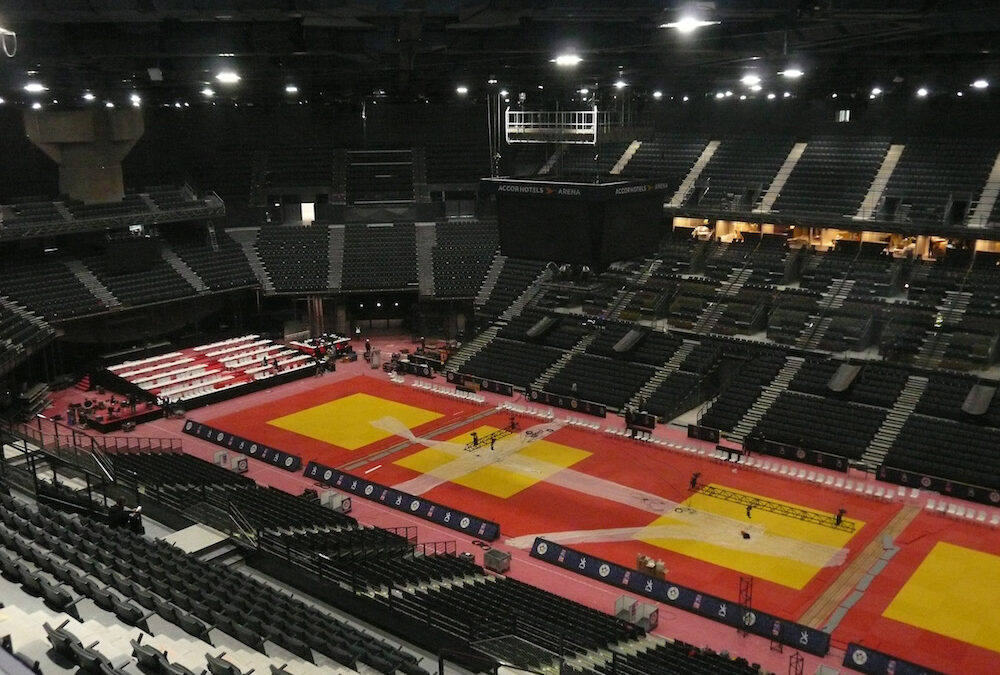
Paris’s famous multi-purpose Bercy Arena has recently been transformed into the flexible AccorHotels Arena following a makeover costing around €150m.
Originally built in early 1981, and affectionately known as ‘POPB’ (a derivation of Palais Omnisports de Paris-Bercy) the maximum seating capacity has been expanded to 20,300, making it the world’s fourth largest arena. The integration of an Optocore / BroaMan digital fiber network in the new look facility allows for 30 different room configurations, enabling it adapt to the range of sporting events and concerts with ease.
While the main design team was led by architects, DVVD and engineers, Populous, the new technical infrastructure was provided by ENGIE Ineo. The company responded successfully to an audio-visual delivery tender issued by project management company, Astell, under the direction of Patrice Buniazet.
With the venue set to host nearly 130 events each year, according to ENGIE Ineo project manager, Marie-Anne Jofret, the arena had to be extremely adaptable in order to meet the requirements of organisers, promoters and spectators alike. An agile network, she knew, would allow the arena to be able to adapt to the multiple configurations required for all hosted events. And this is where Optocore and BroaMan came in.
Conversations with Optocore’s Technical Sales Manager (France), Philippe Moreau set the process in motion, and this was boosted by a trip to see the network in action on the set of long-running British prime time television ‘soap’ Coronation Street.
Here the technical consultants could see the unique, fully integrated transport solution in which all audio, video and data signals could be distributed site wide over fiber from any of the studios or stages. This provided conclusive proof of concept.
“Not only could they see a working installation with the designated equipment for our project, but we also studied a particular case, reviewing the implementation of solutions that we had not previously considered,” Ms. Jofret explained.
The main requirement was to bring greater flexibility and scalability to the site in order to offer production companies a fast response in terms of reconfiguration from all points of the site. “The latency time between sending and receiving signals also had to be extremely low when managing the live events, or at the OB vans for the video part.”
The audio and video networks needed to support the stage set-up as well as ambient sound for the VIP boxes and public and non-public circulation areas. Video links with the OB broadcast vehicles also needed to be provided, as well as DMX for the lighting.
ENGIE Ineo’s chief designer, Thierry Voisin conceived these networks around two Optocore rings – for PA sound and AV infrastructure. The PA sound ring is managed from the front of house PA position, with AES, Mic & Line distributed to the different technical areas via the Optocore interfaces from a Studer Vista 1 console running MADI.
The audio-visual ring is managed from the central control hub and distributed to different technical rooms. Audio signals (AES, Mic & Line) are relayed from a Yamaha QL1 console. This ring also distributes Intercom and Video combining Optocore interfaces with BroaMan Mux22 devices.
The video element of the system is run via various distribution points as point-to-point multi-fiber video or multiplexed in single fiber in order to limit the necessary fiber streaming resources required.
Multiple X6R-FX, X6R-TP and V3R-TP were specified in various I/O configurations (Mic In, Line In, Line Out). Also deployed were X6R-FX-INTERCOM devices equipped with intercom board for Clear-Com, DD32R-FX for AES/EBU and DD2FR-FX for MADI — which connects to the Studer Vista 1 for control of the Optocore mic preamps.
Three new versions bring increased routing flexibility and efficiencies
IBC, Amsterdam, September, 2016 … BroaMan are set to launch three new versions of their popular Route66 router at this year’s IBC2016 (RAI, Amsterdam, September 9-12, Booth #8.C60).
The new 2RU design is a result of customer feedback and the multiple projects already delivered. Going forward, the Route66 platform will provide single channel, non-blocking 40 x 40 router ports in three versions — all with directly accessible fibre SFP (Small Form Factor Pluggable) or SDI. Additionally each new Route66 features fibre ports which can be used to access built-in CWDM or DWDM multiplexers.
The first version of Route66 will offer fibre only, with 40 hot-swappable bi-directional SFPs; Version 2 will have 32 SFPs and 16 x SDI (8-In and 8-Out); Version 3 will have 24 SFPs and 32 SDI (16-In and 16-Out).
The new Route66 provides protocol-independent routing and transport, supporting all professional standards such as 3G, SDI, HD, 3G-SDI, ASI and MADI. The built-in redundant power supplies offer extremely low power consumption of 10-40W making the system significantly more cost efficient than competitive models which depend on external 120W PSU’s. The new models are designed with a very efficient passive cooling system, which replaces noisy fans; therefore the device fulfills all noise criteria.
BroaMan MD, Tine Helmle cites the different combinations of SDI, SFP and CWDM multiplexers as a real advantage. “In addition every SFP port is bi-directional (both input and output) for maximum channel count — unlike many competitive models, which have switchable I/O, thereby losing valuable ports. At the same time custom configuration is easily accomplished on point of manufacture, with on-site change of SFPs, as well as via BroaMan or third party software.”
The new Route66 devices also contain an advanced network from OEM partner Optocore for IP monitoring and control, audio and intercom (eg ClearCom, RTS and Riedel etc), routing and transport — as well as providing additional transport of GPIO, RS485 and LAN.
All connections are to the rear, making Route66 installation friendly. The front panel provides status information only, with no cabling or service buttons.
Finally, Route66 can become a part of a Video AutoRouting System array (as deployed at broadcasters, SVT in Sweden and the new ITV Coronation Street set at MediaCityUK in Manchester).
Other features include: Video Sync transport with sync signals converter for the most commonly used signals: WC, BB, TriLevel; Camera CCU (without power) transport and routing up to 4G; full offline software for preconfigurations.