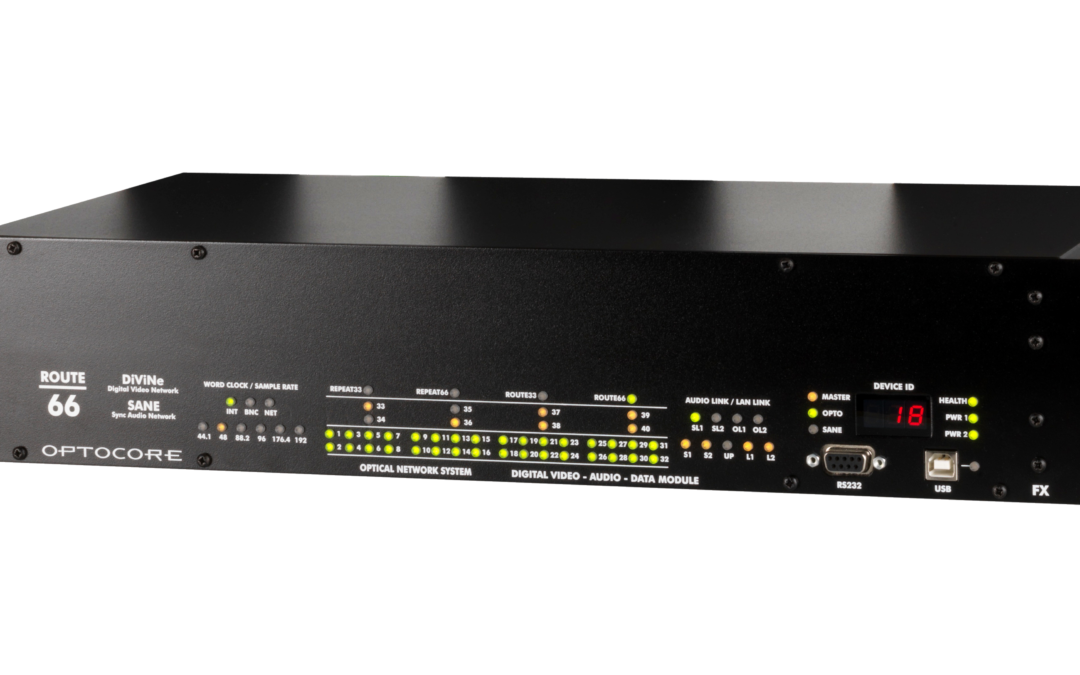
BroaMan has announced a new version of its Route66 video router, now offering AutoRouter and smart fibre patch bay.
This additional functionality is powered by sister brand Optocore, making it ideal not only for Installation (where there are multiple connection points, including mobile devices) but equally for Live Events or Broadcast.
The AutoRouter is compatible with Optocore and DiGiCo fibre loops, creating a redundant ‘star’ out of the advanced ring topology.
It was developed based on customer’s needs, especially in the installation market, where mixed ring/star or star topology is more desirable due to a star based fibre cable layout.
The Route66 AutoRouter automatically finds mobile and remote devices and closes the Optocore loop even when unconnected wall boxes are found. It always switches the links automatically to establish redundancy. New I/O units or consoles are automatically discovered and linked into the system.
Route66 can also be manually set-up to create a smart fibre patchbay with the help of any software used in IT based workflow environments or using stand-alone software. Here it switches any protocol fibre streams, both proprietary ones like camera links, A-link, Hydra, CobraNet and standards like SDI, Optocore, MADI, Ethernet.
Set up as dedicated broadcast suppliers, BroaMan solutions are increasingly being found in the Installation market, including theatres, airports, halls and houses of worship.
States managing director, Tine Helmle, “This device is the only product in the industry which can route Audio Links and Networks of any format, including AES10/MADI. This makes it a perfect match for DiGiCo, Studer, Calrec, Allen & Heath, Yamaha and other premium console manufacturers.”
Managing director Tine Helmle sat down with SVG Europe to discuss the latest additions to the product range, the rise of IP-based workflows, and the changing needs of the sports broadcast market.
1) How would you describe overall activity levels for BroaMan in 2015, compared to 2014?
Achtivity levels have largely been confined to the broadcast, studio, installation (theatres or public buildings), OB Vans and production company sectors. Of these, probably production companies have requested more BroaMan systems than in 2014.
In terms of BroaMan as a company, we have spent much effort on marketing and establishing the brand as being the most solid and cost effective solution to transport video, audio and data over fibre.
2) To what extent have you seen adoption of the BroaMan platform among sports broadcasters, in particular? What are the advantages that it can bring for broadcasters working on this kind of high pressure, time sensitive application?
For sports broadcasters we also sell stagebox connectivity into OB Vans as well as audio and video broadcast infrastructure for stadiums providing connectivity to venue broadcast centres). Advantages include:
Small size and light weight of very powerful units
Plug & play solution – no need to set anything up, just roll a stagebox and go
The ability to run all necessary signals (SDI video, audio in multiple formats, intercom from different brands, data) on single fibre (this can be standard SMPTE 311m fibre) over a very long distance
Software which monitors status of each single fibre transceiver and every single channel
Future proofing for 4K UHD productions
3) What is the latest addition to the BroaMan product range?
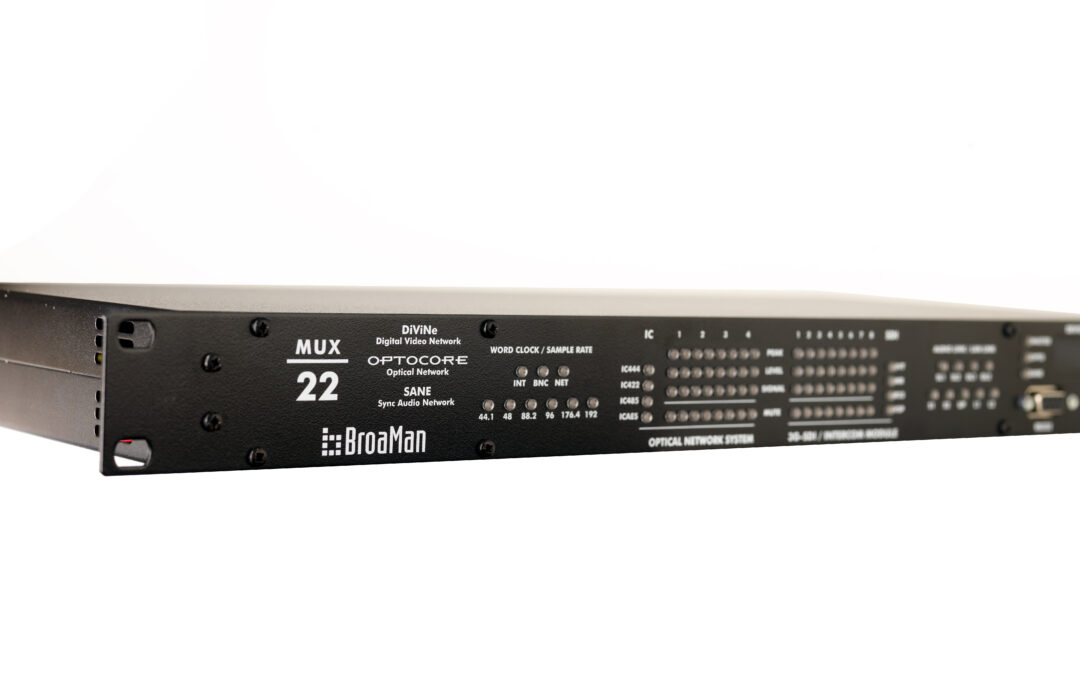
Mux22 is an application engineerded device which offers every signal that is needed in the professional environment in a small 1RU chassis. It supports all main intercom brands(Clear-Com, RTS, Riedel), MADI, AES/EBU and analogue audio, and it’s now also available in a redundant version, offering more resilience.
4) How do you perceive BroaMan’s market position developing as IP-based workflows and remote production begin to gain traction?
We’ve put Ethernet for control into our devices since 2003, and have since 2006 Ethernet in all our devices. We believe that IP-based workflows could be the future. However, at the same time the transport of video/audio over Ethernet is hardly possible unless maybe for very small systems where reliability, flexibility and latency doesn’t matter. Because of the nature of video/audio, those signals must (depends on) dedicated standards such as those defined by SMPTE and AES. For a while, it was difficult to put both Ethernet for control and video/audio on to a single network, so companies tried to convert video/audio to Ethernet to have all on a single network. Fortunately, modern technology with its dark fiber tunnels now allow to have both Ethernet for control and dedicated for control and dedicated low latency ultra-high bandwidth video/audio on the same network.
Broaman is here at the very forefront; we successfully installed many systems with 600G+ bandwidth plus Ethernet for control on a single network. This allows entirely IP-based video/audio workflows and remote productions while at the same time delivering ultra low latency, 100% reliability, redundancy if needed, and easy installation.
5) We see an increasing amount of major sports venues ‘fiber-Ing up’ and preparing for a more networked future. What steps is BroaMan taking to help such clients make this transition?
BroaMan shares technical knowledge as a fibre equipment pioneer. We spent over 25 years on educational efforts, introducing fibre to all markets. BroaMan is also a specialist in networks. As a completely unique feature, we are offering the world’s best audio network (Optocore) while BroaMan offers specially tailor-made and scaled solutions if the client requires them. It is clear that people are no longer afraid (and are aware that) a fibre infrastructure is more cost-effective than copper. We just continue to try and show as many advantages as possible, not only from the technical, but also the financial point of view too.
6) If you had to nominate one recent project that exemplifies what BroaMan can do for sports broadcasters, what would it be – and why?
I would say a major sports league in the USA (we are not permitted to divulge the name). BroaMan equipped ALL stadiums (there were 30 of them) with point-to-point systems consisting of two Mux22 devices in each case. Each system transported video, intercom and data between the goal cameras and the equipment rooms.
7) Finally, please offer a few hints about forthcoming projects and plans.
In terms of projects, a couple of major TV (broadcasters) in Europe are equipping their OB vans with BroaMan stageboxes. Meanwhile, we plan to extend the product line with further solutions for production and rental companies.
Major event specialists GB4D, have upgraded their BroaMan optical fibre network in time for the International Rowing Championships (IRC) which took place recently along a 2km stretch of natural lake in Aiguebelette, France.
It is not the first time that Gilles Bouvard’s company has worked at this location in Savoie, having provided network coverage for a world cup competition on the same site in June 2014. But once the Aiguebelette 2015 organising committee had tendered successfully for this year’s World Championships, they needed to find partners to realise the extreme technical challenges of this broadcast event on a course whose infrastructure had now been revised.
“It was the BroaMan and Optocore optical fibre technology that enabled us to win the contract to create this AV network and provide consultancy,” confirmed Gilles. “The athletes’ village was located 700m from the finish and there were complex audio and video requirements at both spaces.”
To ensure the organizing committee made the right choice for its technical service provider, they had first consulted France TV, who had TV rights for the event. Explaining the scope of the requirement, Gilles Bouvard stated, “Our task was to provide an optical fibre transport solution, with multiplexed HD video and audio signals via Optocore and BroaMan devices. We were selected on the recommendation of France TV, for the quality of our design and the proposed implementation.”
They realised the entire distribution of HD video signals at both locations as well as the full sound reinforcement for the event. “Thanks to the fibre, we were also able to build the computer network for publishing the results collected by Swiss Timing, who managed the timekeeping.
This event provided the perfect opportunity for GB4D to enhance their existing system, comprising four Mux22 devices.
There were two sites from which signals needed to be distributed and at both sites the main points were all distributed geographically, in entirely opposite directions from each other. A ‘star’ distribution system thus became imperative. GB4D’s system in fact allows an even more complex topology — a mixture of dual star — with two main distribution and routing hubs. “In addition to the video, the sound also needed to be distributed — but not necessarily to the same points as the video,” Gilles said. “With the number of audio and video signals to be transmitted only Route66 routers could provide a technical solution for both Broaman and Optocore.”
He thus added two Route66 routers, which have 16 Video IN and 24 video OUT, and are capable of 66 channels of routing, signal repeating, as well as signal conversion between electric and optical. Standards supported include 3G/HD/SD-SDI, MADI, Ethernet, Optocore as well as optical signals from third party devices (eg SMPTE cameras). In this instance they were connected to four satellites, comprising two Mux22 (4-in / 4-out SDI with Optocore); two Repeat 48 (4-out SDI with two fibre tunnels to connect an Optocore device).
“We can transport four video In and four video Out between the two routers, with the possibility to distribute video and audio signals to 10 BroaMan devices located throughout the site. This also allowed us to expand the Optocore loop through BroaMan CWDM multiplexing technology.”
In fact the new set-up enabled GB4D to distribute four video channels to 40 video outputs. “Thanks to the routing system we were able to choose which video went to which output.”
With the use of Optocore Control software GB4D could not only monitor and control audio patching and signal status, but also monitor and control the complete video routing. All crosspoints could be changed in real time with no delay. The software also enabled status monitoring of any single system component from one main control place, and thanks to this, GB4D were always in control despite the system complexity and the long distance between the devices.
For the event itself, one Route 66 was located in the control tower at the finish, with the other in the competitors’ area, with the first enabling them to recover the France Television signals, Swiss Timing (timekeeping), and Great Big Events’ giant screen video signals.
From the control room, they had to distribute the sound and imagery for the public areas, the VIP area, the giant screens, as well as the video to the press room, sound for the gallery TV pictures and radio commentators image to FISA — as well as the Ethernet network for remote amplifiers and the LAN for printing results. For the athletes’ areas, the signal distribution requirements were similar.
Gilles Bouvard had worked closely with BroaMan support technicians in Munich to validate the design. “While routing technology offers huge possibilities, implementation is complex and upon delivery of the equipment, BroaMan conducted training. However, the installation went smoothly and there were no technical issues,” confirms Gilles.
And the overall advantages of the BroaMan technology? “It is the fact that it can create a large virtual hub where video, audio, data, DMX and Ethernet are available everywhere. By using the fibres with four strands the world opens up to you, the possibilities are endless!” The extra strands provides the opportunity for Optocore redundancy for instance, when there is no tunnel available on Broaman equipment.
“The organising committee was delighted with the quality of the signal transmission, and we received several plaudits from consultants saying that we made everything so easy.
“We will continue to extend this multi-format AV signal delivery, to show the full capacity of what can be achieved; but these advanced networks depends on us undertaking further major global events, such as we have delivered in Kuwait and for Radio France in Paris. With this technology we have the innovative tools to accomplish this.”
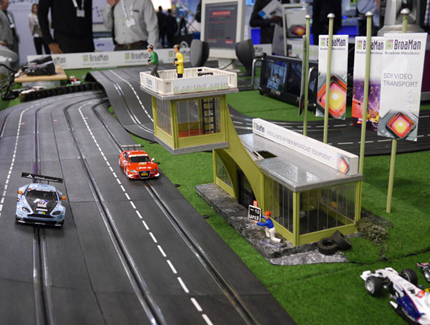
This was no better exemplified than at the recent IBC2015 in Amsterdam where BroaMan’s eye-catching wall display featured two Mux22 devices, interconnected via a Route66 Matrix placed in the Broaman Truck. On the other hand, the presence of the Carrera Four Slot Race Track offered light relief, to accompany the light refreshments constantly being served up by the accommodating hostesses
This ensured a permanent flow of visitors to the stand, causing BroaMan MD Tine Helmle to declare that this had been the company’s most successful trade fair ever.
As for the Race Track, this was an example of an application using a BroaMan stage rack connected with an OB Van — printed as a picture on the wall of the stand but equipped as in real life.
Throughout the entire show BroaMan’s Applications Engineering Manager, Maciek Janiszewski, extolled the values of BroaMan’s unique solutions to potential integrators and end users.
Maciek in particular pinpointed the popularity of the eye-catching wall and the BroaMan truck, to show video routing. He explained the construct: “Each of the Mux22s was equipped with a Clear-Com board to transport intercom data and audio, with four SDI inputs and outputs, and a fibre optic tunnel for third party optical devices
“Two PTZ cameras were connected on the track and controlled over Ethernet from the OB Van with a Sony camera also in use. The fibre optic tunnel transported DiGiCo Optocore for Mic Preamps and Line Output control, and all signals were interconnected between the two locations by one duplex singlemode fibre (up to 10km in length).”
Summing up, Tine Helmle said, “Overall, we received many promising new contacts and partners, and noticed a highly increased perception and interest from worldwide clients in the studio, OB van, government broadcast and live production company sectors.
“The car race track was a huge success, but the real feature was the ‘truck’ wall, with the BroaMan and Optocore devices plus ClearCom Intercom and RTS InterCom matrix built in. Visitors loved it. “
BroaMan (Broadcast Manufactur GmbH) will use this year’s NAB 2015 in LAS VEGAS to preview a vital new addition to its growing MUX22 series (at Bavarian Pavilion, booth C8831).
The company, which specialises in providing customised solutions for broadcasters with SD/HD/3G video transport requirements, last year launched the original MUX22 video, audio and intercom module. This formed a central part of BroaMan’s scalable and protocol independent philosophy, offering up to 16 3G/HD/SD-SDI I/O configurable video ports with built-in CWDM multiplexer (allowing multiple signals to be multiplexed over just one single fibre each).
Following the development of the MUX22 series via Intercom for RTS, Clear-Com and AES as well as IC444 (4 Line In, 4 Line Out, 4 GPIO), they have now produced the MUX22 MADI, making the platform compatible with the industry standard MADI audio format.
As with all MUX22 devices the new MUX22 MADI will support up to eight video channels with a selectable number of dual inputs and dual outputs; it is also equipped with a Sync Board for Video Tri/Bi-Level or Audio Word Clock sync, either with RS485 or GPIO ports, and can provide fibre tunnels for any third party products.
The new MADI board is populated with four duplex SC MADI ports, offering 256 inputs and 256 outputs, and each MADI port is fully AES10 compatible, offering 56 or 64-channel MADI I/O. The audio engine is equipped with a single channel router, enabling routing from/to any MADI stream, either within the same device or between the remote Optocore, BroaMan or ProGrid devices.
Said BroaMan MD, Tine Helmle, “The strategic importance of this product is that it will allow great benefit to the broadcast industry because with the digital audio option in addition to the analogue ones, it allows a complete and transparent video, audio and control transport solution based on open platforms. Therefore, any device from any brand can now be networked through MUX22, and any style video, audio, intercom, lighting or ethernet control. We have already taken first orders, including one from Denmon.”
The MADI implementation is bit transparent and passes third party control protocols. Also through the MUX22 environment, Optocore’s award-winning Mic Preamps can be controlled from many third party devices, either with direct access (e.g. DiGiCo) or through the company’s Emulation Modes (e.g. Lawo, Studer, Soundcraft, SSL and Yamaha).
Finally, Mux-22 MADI can be used as a point to point system with any other MUX22 device, or in a star or ring topology with Route66 devices as part of a larger routing solution.
The product will commence shipping immediately after the show.