The integrators have frequently turned to BroaMan fiber transmission solutions when carrying out OB fit-outs for the country’s leading broadcasters.
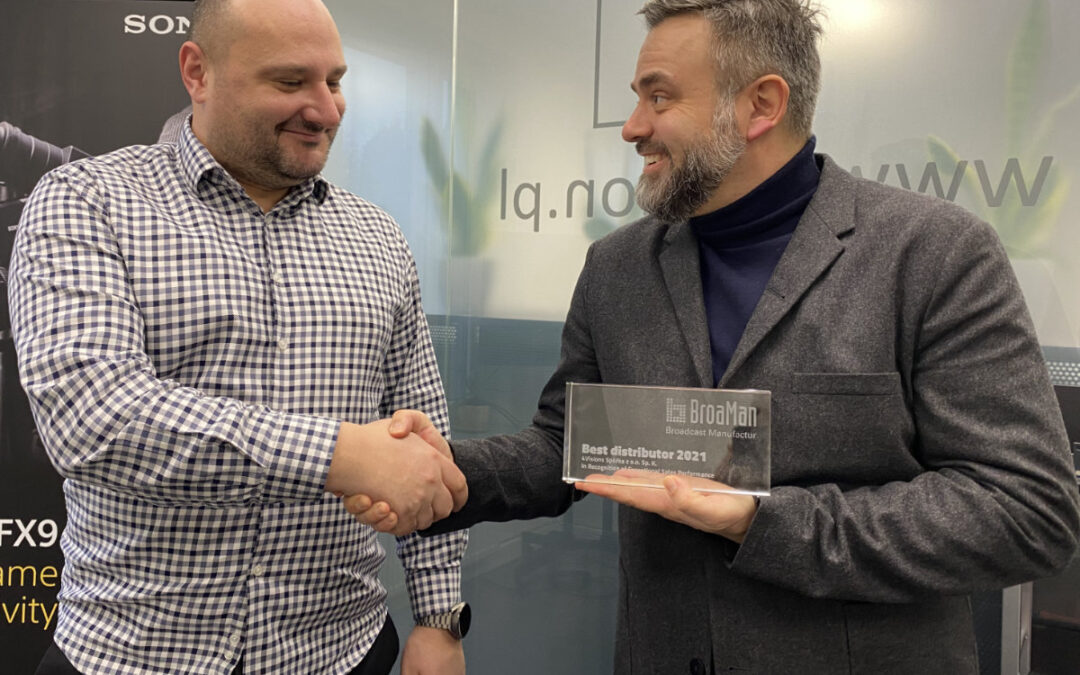
BroaMan Sales Distribution Manager, Dawid Somló, said the company were worthy recipients. “4vision are the most experienced OB van builder in Poland, and when they are awarded a project or a commission for a new truck they routinely propose our solutions. We are in contact with them on a weekly basis and thanks to this relationship sales activity has been especially high amongst OB van users.”
Somló was impressed that despite COVID lockdown, the company maintained online meetings with customers (and in-person where possible) explaining the benefits of BroaMan systems and advocating ways of deployment. “In addition to this, their after sales support is excellent,” he says. “All of this has resulted in a highly positive reception of our brand and a pipeline to future requirements from the Polish broadcasters.
“It is 4vision’s confidence in our technology, coupled with technical knowledge and experience, that presented compelling reasons for awarding this honour.”
The plaque was presented to 4vision commercial director, Daniel Augustyniak by Dawid Somló (pictured left to right).
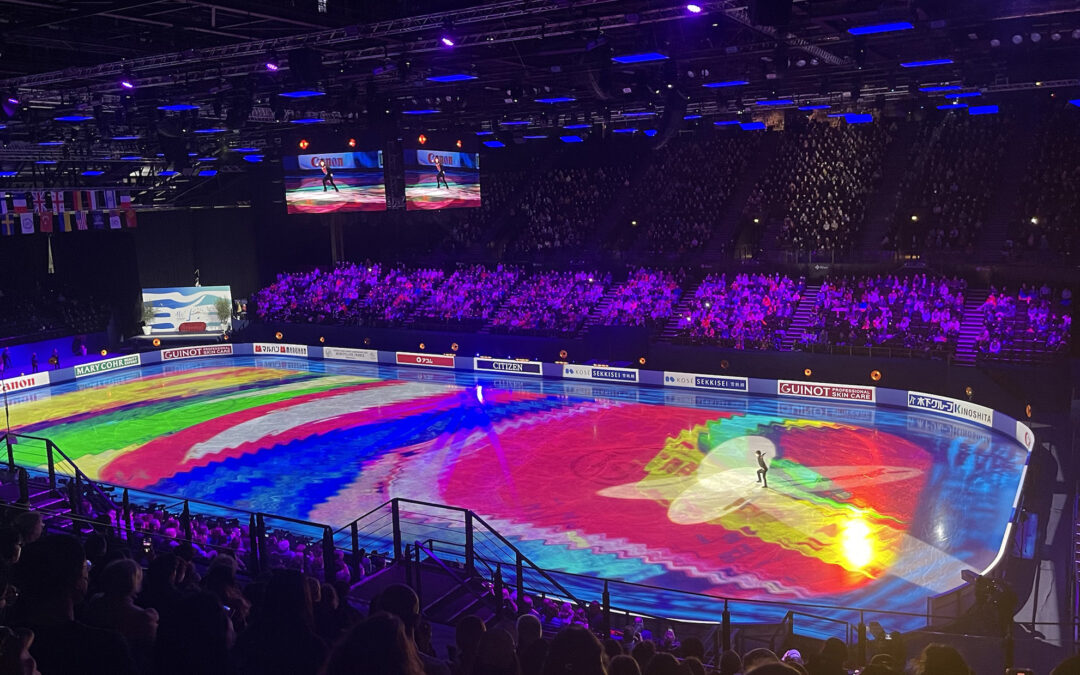
When the 2022 World Figure Skating Championships were held recently at Montpellier’s South of France Arena, technical solution provider (and Optocore partner) GB4D, was called on to provide an elaborate communications network for all the technical elements. This included Optocore and BroaMan routing, designed in a star topology.
The event itself was organised by the French Federation of Ice Sports, and the integrators were contracted by Charles Gueydan, their technical production manager.
Under the direction of proprietor Gilles Bouvard, GB4D has a rich pedigree in that sector, having previously worked on the European Championships in Lyon in 2006, and later the 2012 World Championships in Nice. On top of that, for nearly two decades they have been involved with the televised Les Étoiles de la Glace, the French Federation’s skating gala.
This year GB4D was entrusted with providing the entire audiovisual network, as well as Intercom; Sound system; Sports and production lighting (including bridges); Stage structure and Video for the 4-sided LED screens. They worked alongside Patrice Burle from Concept-Group for the structure and lighting accessories, while lighting creation was the responsibility of DoP, Tony Weber and sound design by Titou Victor and François Iund.
GB4D turned to a combination of Optocore / BroaMan interfaces, along with DiGiCo digital mixers and L-Acoustics Kara /K2 PA as they have for many large-scale events previously.
The biggest challenges they faced were the restricted assembly time (seven semi-trailers of equipment needed to be installed and ready to operate in 12 hours), and the trim height, with more than 80 motors at 22m height, to provide full visual clearance.
Gilles Bouvard emphasised that there had been no room for improvisation, since once the assembly was completed, and all compliances met, access to the ice was forbidden. The network was formatted and designed by François Iund. The entire video element was distributed by BroaMan interfaces, including Mux22 MADI and Mux22 IC444, along with Repeat48 and Route66 devices. This provided distribution of the signals from the OB broadcast, as well as all the timing element and the insert capture camera, with video management under the direction of Emilien Vaast.The Optocore network, which allowed for 320 inputs and 384 outputs, was in redundant five-point star design. Optocore M12 and DD4MR-FX interfaces provided all MADI connectivity, with X6R-FX and TP 16-channel converters at the heart of the system. For the BroaMan element the network was configured as a non-redundant star.
The IP network was managed by redundant Gigacore Luminex PoE interfaces for, among other things, lighting and intercoms. Sound sources included music for the skaters—broadcast by two MAC Mini players equipped with QLab software—as well as ads and other presentation background music or jingles processed by a Broady Solutions MT128 multitrack machine. This came out in MADI 128 I/O via Optocore M12s, allowing different streams to be routed on several simultaneous outputs. Other sources included video soundtracks, managed from the two video control rooms. Finally there was the ‘official speaker’ mics for the ISU, plus UHF microphones for interviews and animations. For mixing and managing audio streams, GB4D installed a DiGiCo SD12 for the main mix (including broadcast) and SD11 for the ‘Player’ control room. Flow management in the Optocore network for broadcast was managed from FOH via the SD12. The entire network was managed from the FOH control room. The flow distribution from the star system included: Diffusion systems hung in the walkways with three distribution points; Players management; AMP Visual OB broadcast Van and the Press Centre. All these locations received audio, video and IP.
The international signal was provided in Mondovision since it is a world championship, while France Television was the broadcaster for the domestic audience.
As for the event itself, in such a reverberant space as an ice rink, the most difficult challenge had been to guarantee suitable SPL and a perfect listening performance, states Gilles Bouvard. “The judges, positioned at the edge of the track, and skaters who use the entire 60m x 30m ice, had to share the same listening experience. If a skater were to complain about the sound, it would have become a very big problem—so everything had to be perfect. “My audio technical team carried out a top-notch acoustic study so that the sound was uniform from the centre of the rink to the top of the stands. Titou Victor and François Iund implemented this plan to perfection.”
Key to the technical success had been the perfect functionality of data distribution, he confirmed. “Optocore and BroaMan provided the essential tools to construct a star network; the Route66 and Optocore AutoRouter operated between the five different points, all of which received audio, video, data, intercom networks,and 22 DMX lighting universes.”
He added that the network also had to be sufficiently robust to provide feeds to other partners such as Swiss Timing for the competitive element, and international TV broadcasts.
“For these partners we had to be able to share data flows—and we could do this with ease thanks to the ‘hot’ routing possibilities which Optocore MADI grids or BroaMan Route66 video routers allowed. This gave everyone complete peace of mind.”
After working on many projects using Optocore solutions in the past, Seoul-based Ingang Audio Co has been formally appointed as new South Korean distributors for Optocore and associated brand, BroaMan, with immediate effect.
Established in 2006, under president Joo Hong Chang and CEO Steve Kim, Ingang Audio has an enviable portfolio of global pro audio brands, including Meyer Sound, Calrec, Countryman, Samson and Lectrosonics.
Both Mr. Chang and Technical Director, Eric Han had known Optocore and BroaMan for many years and the latter has received Optocore training. The company had also had developed a good relationship with Optocore Distribution Sales Manager, Dawid Somló and the tech team during earlier project development.
“Ingang had been talking with us for long time,” said Somló. “They are an excellent pro audio company with a good infrastructure. They are keen to develop their portfolio with our video transporting systems and also add them to their audio projects.”
Ingang Audio Co’s Senior Marketing Manager, Jake Min, agreed that the move into distribution was a logical progression after so many experiences together. “Having Optocore and BroaMan [in our portfolio] is like securing a backbone for our brands. We now have optical paths for sending and receiving audio/video/intercom and some control signals. Also it enables us to make an optical connection between loudspeaker, processor and console, replacing the existing cables.”
As for BroaMan, they hope to expand the brand’s outreach beyond broadcast into theatre, although Min estimates that with the impact of Covid-19, THE broadcast segment will lead the way rather than live events.
To that end they already have a project lined up, with two sets of Optocore M12 OPT/BNC MADI switches being installed in a large broadcast hall, for splitting and sending MADI signals to several consoles for PA, broadcast and stage monitoring.
Meanwhile, in their showroom will be demo racks featuring Optocore Festival Box Petit, M12 and X6R, while pride of place for BroaMan will be the best-selling Mux22 series.
Summing up the impact of adding these new market-leading fiber-based brands to their portfolio, Jake Min foresees many advantages. “It means we will be able to send various signals via Optocore connection to far away distances using a light weight solution. Secondly, Optocore and BroaMan have reliable redundancy such as dual power as well as dual connection. And with a decentralised network they can support various network topologies.
“In short, they are a very experienced brand that we firmly believe in.”
ERR is the largest media organisation and government-owned radio and television public broadcasting company in Estonia.
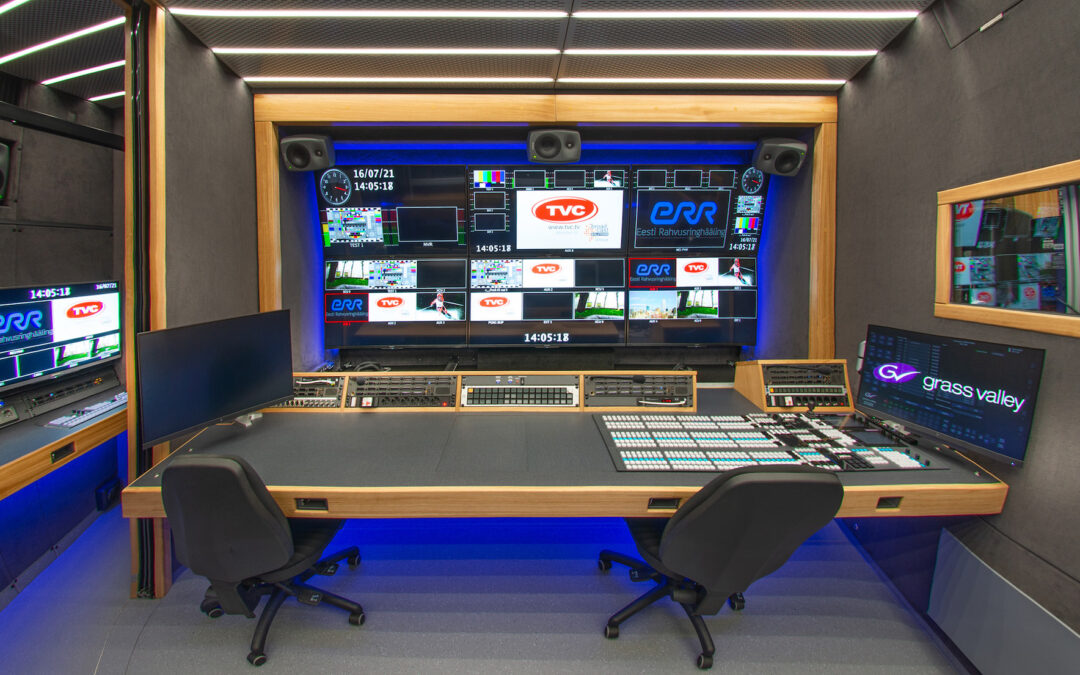
For its mobile units, the organisation relies on the experience of Lithuanian-based TVC Solutions, who have been designing and coachbuilding OB vans for over 20 years, and the fit-out includes specifying the most efficient, state-of-the-art technological infrastructure.
A key feature of the latest 12-metre long 18-camera van (designated ‘OB-1’) is an efficient use of internal space. They were able to create five working areas, and in total 19 separate workplaces on a chassis-based design. This includes: Main isolated equipment racks with redundant cooling system; Shading area (four workplaces); Second programme area (three workplaces); Main programme and slow-motion operators’ area (10 workplaces) and an advanced Audio room with improved sound isolation. OB-1 can operate with either one or two expanded sides.
The audio control features advanced, point-to-point signal transport over fibre from a pair of the increasingly popular BroaMan Mux22 IVT/IVT devices, which are fast becoming ‘go to’ solutions for complex multi-format transmission such as this. Selected for this purpose by the customer, different formats of video and data can be combined and transported down a single duplex fibre cable. It is possible to control and monitor every channel and transceiver in the device in real time remotely using Optocore Control application.
In this instance Mux22 has been custom-configured as a point-to-point pair as required, to transport multiple signals between any two locations, reflecting the OB van’s widespread use for sports, news coverage and other outside broadcasts.
One Mux 22 IVT / IVT has been configured with 10 x 3G-SDI IN and 6 x 3G-SDI OUT, with 2 x PSU, SM Optocore Link, 2 x SANE/LAN/MADI Cat5, 2 x LAN, 4 x GPIO, 2 x COM, a VSYNC I/O and two 1310nm Aux. The second Mux 22 has 6 x 3G-SDI IN and 10 x 3G-SDI OUT, with 2 x PSU, SM Optocore Link, 2 x SANE/LAN/MADI Cat5, 2 x LAN, 4 x GPIO, 2 x COM, a VSYNC I/O and 2 x 1310nm Aux.
According to TVC Head of TV System Design & Integration, Vitalijus Kaunas, the client is more than satisfied with the possibilites afforded by the Mux22 platform.
This is just part of a highly sophisticated construction, that in addition to the expandable sides, includes a quick to deploy and improved, fully electric side expansion and self-levelling system, which takes much less time to deploy than previous versions, as well as power, HVAC, lighting, and control systems—all based on Estonian climatic conditions.
The technical infrastructure comprises broadcast industry standard components, built around the 18 x Grass Valley LDX 3G cameras and LAWO MC56MK3 48-fader console.
Total Solution Marketing supports The Show Company Ptd Ltd for display at The Float @ Marina Bay
BroaMan MUX22 fiber multiplexer and Repeat 48 3G/HD/SD-SDI Video/MADI fiber extender were provided by Total Solution Marketing (TSM), along with full service support, for the recent Singapore National Day celebrations. The event this year was rescheduled by the Government from its traditional August 9th date to August 21st due to the increase in COVID-19 cases.
Fireworks of Singapore National Day in Downtown Singapore city in Marina Bay area at night. Financial district, The Ferris Wheel, and skyscraper buildings.
These interfaces were deployed by The Show Company Pte Ltd, the appointed vendor of the Multimedia Committee for this year’s National Day Parade. The fiber-based solutions were used between transmitters and receivers, across distances averaging 250 metres—over LC multimode fiber to three different camera locations.
This enabled all data to be transported over a single duplex fiber, thus reducing the number of the cables otherwise necessary over long distances. At the same time it ensured extremely low latency in the transmission.
CWDM-equipped MUX22 devices, configured 8 x 3G/HD/SD-SDI In/Out, and with RTS 4-wire intercom, were used in all Augmented Reality (AR) camera transmissions: Camera Signal Out (HD-SDI 1080p@50Hz); Camera PGM In (HD-SDI 1080p@50Hz); External Sync via Genlock sync generator (black burst), as well as IP addresses in the form of Lens Data for Camera Tracking and IR Sensor; Camera Tracking Data and Robotic Arm Remote Control.
The Show Company Pte Ltd also used Repeat48 as a means of signal transmission over a multicore singlemode fiber to send six channels of HD-SDI LED content feeds (three main signals and three back-up) to Mediacorp’s OB truck. These signals comprised Graphical Content (in 16:9 aspect ratio); LED Program Feed (in 16:9) and Multi-Cam Production Program Mix (with subtitles).
The spectacular event itself was divided into a main parade, at the Marina Bay Floating Platform, and then the show itself—a spectacular song-and-dance extravaganza. While both the Parade and show segment had to be scaled back for Covid reasons, as always it provided a fitting commemoration of Singapore’s independence in 1965, with a riveting aerial display enjoyed by around 1,000 people the main highlight.
Delivered in Singapore’s four official languages, the National Day show was broadcast across Mediacorp’s free-to-air TV channels, as well as radio stations, their own digital streaming platform, meWATCH and YouTube.